Courtyards at Southpoint
April 2026 Speaker Series
Climate Change Accelerates, But Can be Stemmed
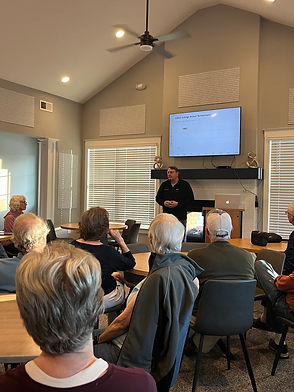
Climate change is one of the biggest challenges humans face, Peter Vedder reported during the Courtyards at Southpoint monthly Speaker Series, “Addressing the Climate Challenge From Space.”
But if people work on the problem with broad-based cooperation, positive results are possible, he told neighbors at the Social Committee-sponsored event April 9 in the clubhouse.
Peter is a Massachusetts Institute of Technology-trained astrophysicist who directs satellite operations for the Environmental Defense Fund. He outlined the causes and extent of climate change, as well as a project that addresses the challenge.
The first metric to address is global temperature, he said: “Scientists take temperature data from across the planet for a given year and compare it to a baseline. That is the period from 1850 to 1900, the preindustrial era before we started burning stuff. Since the 1920s, temperatures have been going up and up. This is what people refer to as global warming.”
Peter offered several takeaways from the temperature data:
-
Globally, the hottest 10 years on record have been the pasts 10 years. “It’s not like this is a fluke,” he said.
-
The hottest year on record was 2024, and last year was just a little cooler. “That may be the ‘coldest’ year we experience the rest of our lives,” he noted.
-
The planet not only is getting hotter, but the heating is accelerating. The rate of average temperature increase has doubled since 2013.
-
Because of rising temperatures, crops will not grow in their traditional areas, so farming must shift to new locales or food supplies will shrink.
-
Sea temperatures are steadily rising. This is significant, because “heat in the oceans is what drives weather patterns.”
-
Ice formations in the Arctic are declining, and glaciers are melting rapidly in Antarctica and Greenland. Consequently, rising sea levels are threatening coastal cities where 2 billion live.
-
Extreme weather patterns — from escalating wildfires to major storms, such as Hurricane Helene flooding Asheville — are getting both stronger and more frequent. “Once-in-a-thousand-year storms are taking place every week,” he said.
-
Both extreme cold and extreme heat are caused by climate change. “The results of rising temperatures make both record highs and record lows possible,” he explained. “This has to do with how the atmosphere behaves throughout the year.”
“It’s not a future problem; it’s going to get worse,” Peter warned. “We ignore it at our own peril — and particularly for our children and grandchildren.”
The cause of this climate change is the “greenhouse effect,” which traps sunlight-generated heat near the earth, he said. The most well-known cause of the planet’s heating is carbon dioxide, which has increased 36% since 1958.
Claims that the warming is “natural” or “what it was like thousands of years ago” have been debunked by comparisons of modern air measurements to data from ice cores, which provide time capsules of air quality across thousands of years, he said.
“For millennia, atmospheric carbon dioxide had never been above 300 parts per million,” he noted. “This was true until about 1958, when the amount started going straight up.” Most recently, the amount of carbon dioxide in the atmosphere increased by almost 50 percent.
“Another prominent greenhouse gas, methane, is 80 times more powerful in heating the atmosphere as carbon dioxide,” Peter said. “Methane doesn’t last as long in the atmosphere, but in the short term, it has a major impact.
“Carbon dioxide tells you what the temperatures are going to be, but the rate at which we get there is up to methane.”
Atmospheric methane — which causes more than 30% of human-triggered global warming — has increased by 18% since 1983, or about 4.3% per decade, he said. Now, three times as much methane exists in the atmosphere as at any time prior to 1900.
To reduce methane, we have to figure out its sources, Peter said, noting the two greatest sources are oil and gas production, which emits 28% of atmospheric methane, followed closely by livestock, which emit 25%.
Through the Environmental Defense Fund (EDF), Peter has been working on a project to identify specific sources of methane and to mitigate its release.
“We’ve got to slow down methane emissions to prevent irreparable damage while we take care of (reducing) carbon dioxide,” he explained.
Peter showed a map of the Permian Basin — an 86,000-square-mile section of Texas and New Mexico — that emits 440 tons of oil and gas methane per hour.
The average North Carolina home uses one ton of natural gas per year. So, the leakage from just one hour in the Permian Basin could fuel 440 homes for a year. On a larger scale, the basin’s annual leakage could fuel almost 3.9 million homes per year.
Traditionally, researchers used airplanes to fly over the area and gather air samples to try to determine both the locations/sources of emissions and the amount of methane released into the air.
The EDF demonstrated the need for repetitive, global, high-precision methane measurements that can only be accomplished from space, Peter reported.
So, the EDF spearheaded MethaneSAT, a satellite specifically designed to measure sources and amounts of methane emissions, as well as to make the frequently updated data free, publicly available and transparent, he said. This was the first satellite mission led by a nongovernmental organization and philanthropically funded.
“This project was not beholden to government and didn’t have to make a profit,” he said. “Our assignment was to just get the information.”
In simplest terms, the satellite could measure sunlight bouncing off the earth. Methane absorbs sunlight and has its own distinctive markers. So, scientists could pinpoint both the exact locations of emissions and the amount of emission.
The satellite launched in March 2024 and transmitted until June 2025. During those months, the EDF monitored 41 oil and gas regions that comprise 50% of the planet’s oil and gas production. It collaborated with 29 countries, and more than 800 users accessed the data.
The findings showed 75% of the methane leakage derived from small sources — particularly old wells. “Simple maintenance could knock down a lot of it,” Peter said.
“Across the globe, there are a lot of places that are leaking methane” he added. “When you translate how many homes could be heated, it’s just staggering.”
Regulations of oil and gas production can make a measurable difference, he stressed. For example, although the Permian Basin production field covered identical terrain, leakage in New Mexico, which more highly regulates the industry, was significantly less than leakage in Texas.
“This shows reducing emissions can be done if there is the will to do it,” Peter reported.
“We have a lot to do to reduce outputs,” he said, noting the United States is repealing an endangerment finding that provides the legal basis for allowing the Environmental Protection Agency to regulate methane production. “The government also is closing down clean-energy projects. So, rather than looking for clean energy sources, they are putting up a major impediment,” he said.
The path for reducing methane emissions is broader adherence to the Global Methane Pledge, an agreement “to take voluntary actions to contribute to a collective effort to reduce global methane emissions at least 30% from 2020 levels by 2030.”
The pledge counts 159 participating countries and the European Commission, he reported.
“This pledge provides the mechanism to work together to build guidelines for how to do methane reduction,” Peter said. “The United Nations is aggregating all the data and publishing an annual report.”
Also, more countries and individuals are adopting clean energy options, such as the use of solar power and adoption of electric vehicles, he added. For example, 92% of vehicles in Norway now are electric-powered. Globally, solar energy generation has doubled over the last three years.
And more than 40% of global energy production now comes from noncarbon sources — solar, 7%; wind, 8%; other renewables, 3%; hydro, 14%; nuclear, 9%. Other satellites will take the place of the EDF’s MethaneSAT to provide future data.
Environmental responses take a long time, but they are doable, he said, mentioning the successful diminishing of the atmospheric ozone hole that has resulted because chlorofluorocarbons (commonly known as CFCs) were banned.
“We need to take action today — not for ourselves, but for our kids and grandkids,” Peter urged. “We must pull together with the same political will, sense of purpose and collaborative approach to all work together to find solutions.”